Deep vs Light Hypnosis:
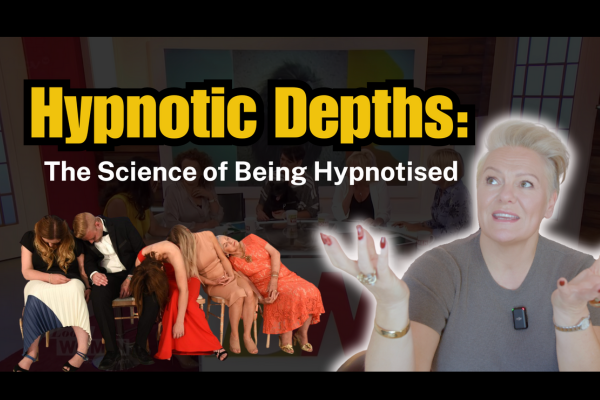
Depth in hypnosis is not about how unconscious someone looks. It is about how responsive their brain becomes to suggestion. Even if a person appears alert, they can still be deeply hypnotised because hypnosis depends on precision, focus, and conditioning, not sleep or surrender.
What Does “Depth” in Hypnosis Actually Mean?
Depth in hypnosis describes how absorbed and responsive a person is. It is not about being switched off but about tuning in.
During hypnosis, awareness narrows, inner dialogue fades, and the automatic part of the mind takes the lead. That is why two people can look completely different during the same induction yet both be hypnotised.
The person who appears deeper has simply stopped analysing and started following. In hypnosis, responsiveness is the real measure of depth, and it can be trained through repetition and focus.
Key point:
Depth equals responsiveness, not relaxation.
Why Older Models of Hypnosis Are Misleading
Early hypnotists created detailed depth scales such as the Davis Husband, Arons, and Stanford models. These described trance in thirty or more stages, with terms like somnambulism or the Esdaile state.
Those scales were designed for laboratories, not therapy. They measured observable reactions rather than meaningful change.
Most people achieve transformation in a light or medium trance, where awareness and responsiveness meet. Deep trance can be useful for anaesthesia or amnesia but is not necessary for behavioural change.
When hypnosis is repeated over hours, the idea of depth begins to blur. What matters most is not how deep someone goes but how fast their brain learns to respond.
What Happens When Clients Use Recordings Before a Session
Before a client’s first live session, I give them a short hypnosis recording to listen to several times. This primes their mind and body for the process ahead.
Each time they listen, their brain begins to recognise my voice, rhythm, and tone as signals for relaxation and focus. This repetition builds familiarity and strengthens the neural pathway that connects my voice with calm and receptiveness.
The process is known as fractionation — each exposure teaches the mind to enter hypnosis more quickly and easily. By the time we meet, their brain already understands the pattern, allowing for a faster and more precise induction.
This is not about control. It is conditioning. The client’s nervous system learns to respond efficiently because it associates my voice with safety and focus.
As a result, the live session becomes more effective from the very start. The client’s mind is already primed to follow suggestions and reach the desired state with clarity and confidence.

What Science Reveals About Hypnosis and the Brain
During hypnosis, the prefrontal cortex, which handles monitoring and questioning, becomes quieter. At the same time, the anterior cingulate and insula, which manage attention and body awareness, become more active.
With repetition, the brain learns that responding to the hypnotist is safe and beneficial. It becomes easier to follow suggestions because the nervous system is trained to enter that state.
It is like learning to dance. At first, the steps are clumsy. With practice, the rhythm becomes automatic. Every successful trance cycle strengthens this conditioning, creating faster and more fluid responses.

How the DELETE Method™ Redefines Hypnosis Depth
In the DELETE Method™, the goal is not depth but precision. Depth happens naturally once precision is achieved.
When I use the DELETE command, I am not waiting for someone to be deep enough. I am targeting the exact thought loop where an idea turns into an emotion.
Delete the thought, and the emotion collapses. The posture and behaviour follow automatically.
This process can happen in seconds because when the body feels safe, the mind clears. When the mind is calm, the body relaxes. That is the loop we rewire.
I do not rely on depth scales or trance tests. I reach the same level of subconscious access through tone, breathing, and micro-movements, often within thirty seconds.
That is precision hypnosis — fast, focused, and reliable.